


Design Thinking in federal modernization is a leadership discipline that helps GovCon leaders frame problems more effectively, reduce friction in delivery, and improve adoption by focusing on human-centered outcomes from the start.
Why Design Thinking Matters in Federal Modernization
About sixteen years into my career as a designer, my perspective on the work changed in a way I didn’t expect.
Until that point, most of my focus had been on the craft itself—solving specific design problems, refining interfaces, and delivering the best possible solution within the scope of a project. I cared deeply about the details of the work, but my lens was still largely focused on the assignment directly in front of me.
Then I had the opportunity to travel to Toronto with a small group of colleagues for intensive training in Design Thinking, in the IDEO tradition, through ExperiencePoint. Our goal was to learn the discipline well enough that we could return and teach it to the rest of our mid-sized company.
What surprised me most during that experience wasn’t the tools or the frameworks. It was the realization that design thinking wasn’t meant only for designers or software teams. It was truly meant for everyone.
Design thinking applies just as easily to the person greeting visitors at a front desk—or designing the perfect toothbrush for kids, or rethinking a community system—as it does to a team building complex technology. At its core, it was simply a way of approaching problems with curiosity and empathy—taking time to understand the people affected by a decision before rushing toward a solution.
That realization reshaped how I approach my work and vastly amplified its impact.
Over the years since that training, I’ve found that the most effective leaders in government consulting aren’t necessarily the ones with the most technical expertise. They are the ones who consistently ask human-centered questions: Who will this affect? What pressures are people working under? How will this decision play out in the real world? Why?
In other words, they lead with an intentional pursuit of the big picture–for the sake of creating a human-centered ecosystem in which the user and stakeholder needs are seamlessly addressed while guiding the required outcomes.
And when leaders approach modernization efforts from that perspective, the systems they build tend to work better—not just technically, but operationally for the people who depend on them every day.
The Leadership Gap
Over the years, I’ve had the opportunity to work on design from a few different vantage points.
Sometimes I’ve been deep in the work itself—designing interfaces, shaping workflows, solving UX problems alongside delivery teams. Other times I’ve been zoomed out, thinking about the broader experience of an organization: its brand, its communication, the way people move through systems and processes every day.
From both perspectives, one pattern tends to surface.
Many of the challenges we see later in modernization programs—confusing workflows, slow adoption, heavy training requirements—don’t actually originate in the technology. They begin earlier, when teams are defining the problem they’re trying to solve.

Federal programs operate in environments that value structure and accountability. Requirements must be defined. Milestones must be met. Those guardrails are important. But when programs move quickly from identifying a need to specifying a solution, something subtle can happen along the way: assumptions about the user experience become embedded before anyone has truly examined them.
Delivery teams then inherit those assumptions and do their best to work within them.
This is where leadership perspective matters. When leaders approach modernization through the lens of design thinking—taking time to understand the people, workflows, and contexts behind a problem—teams start from a much stronger foundation.
In that sense, design thinking is not just a design practice. It’s a way of thinking that shapes how leaders frame problems in the first place.
What Design Thinking Looks Like at the Leadership Level
Design thinking is often associated with brainstorming sessions, sticky notes, or UX workshops.
But in my experience, its most powerful impact shows up earlier than that—in the questions leaders ask before a project ever begins.
Instead of jumping straight to features or tools, or making assumptions based on what’s been done before, design-minded leaders tend to pause and ask things like:
- Why is the current state the way it is?
- Who will actually use this system in their day-to-day work?
- What pressures shape the decisions they make throughout the day?
- Where does friction already exist in the workflow?
- What assumptions are we making that might not hold up in practice?
These questions might seem simple, but they shift the direction of an entire initiative. They help teams frame outcomes before developing solutions.
When leadership takes this approach early, it changes the trajectory of delivery. Architecture decisions become more intentional. Requirements align more closely with real workflows. Teams spend less time retrofitting usability later because the human context was considered from the beginning.
I’ve seen this dynamic play out across federal programs. When experience design enters the conversation early—before major technical decisions are locked in—the entire effort tends to move with more clarity and less friction.
The result isn’t just a better interface. It’s a system that fits naturally into how people actually work.
Innovation Requires Structure
Of course, leadership mindset alone doesn’t create innovation.
Federal environments operate under strict governance, security requirements, and accountability standards. Innovation can’t simply mean experimenting freely. It has to happen within a structure that protects mission outcomes and public trust.
This creates a challenge many organizations recognize: Teams want to explore new ideas and technologies, but they also need to move carefully.
Without structure, experimentation can feel risky. Without space to explore, innovation stalls. Design Thinking helps leaders frame problems more thoughtfully, but organizations still need environments where ideas can be tested and refined before they become enterprise systems.
In other words, innovation needs both imagination and discipline.
Innovation is a Team Discipline
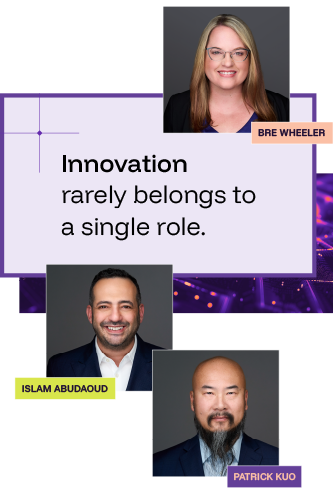
Another lesson I’ve learned over the years is that innovation rarely belongs to a single role. It tends to emerge when different perspectives come together around the same problem. At Diaconia, that collaboration shows up in how we approach design, delivery, and innovation.
My role focuses on the broader experience landscape—looking at how systems, brand communication, and user interactions connect across programs and organizational touchpoints.
Islam Abudaoud brings deep expertise in human-centered design within delivery environments. His work ensures that UX decisions stay grounded in real technical and operational constraints while keeping user needs at the center of development.
As Diaconia’s VP of Innovation, Patrick leads the development of the ecosystem and infrastructure needed to empower our clients to move responsibly into the ‘beyond’ with their mission capabilities.
Together, these perspectives create a balanced model for innovation: leadership framing through design thinking, operational rigor through human-centered delivery, and structured exploration through research and development.
Designing for the Unknown
Modernization is ultimately about moving into the unknown.
Agencies are adopting new technologies, adapting to evolving mission needs, and responding to changing expectations from the people they serve. No matter how carefully we plan, there will always be uncertainty along the way.
What makes that uncertainty manageable is the mindset we bring to it.
Design thinking gives leaders a way to navigate complexity with empathy and curiosity. It encourages teams to question assumptions, listen closely to the people affected by their systems, and iterate thoughtfully rather than rushing toward predetermined answers.
When that mindset is paired with structured environments, innovation becomes something organizations can approach with confidence—not as a leap into the dark, but as a disciplined process of discovery.
In federal modernization, the most important design decisions often happen long before an interface is built. By embedding human-centered design into planning, delivery, culture, problem-solving and decision-making, adoption-rate and buy-in become woven into the user experience and ultimately produce a seemingly personalized experience. Trust is embedded. Outcomes are ensured.
About the Author
Bre Wheeler is the Senior Director of Digital Services at Diaconia, where she leads design, brand, and digital strategy across client programs and internal operations. With hands-on experience as a UX/UI specialist on federal software modernization efforts, Bre brings a practitioner’s perspective to design leadership in government consulting.
Ready for next-level tech design partnership?
Learn about how we work to understand our approach, and get a big picture grasp on who we are, what we do, and how we do it.
